

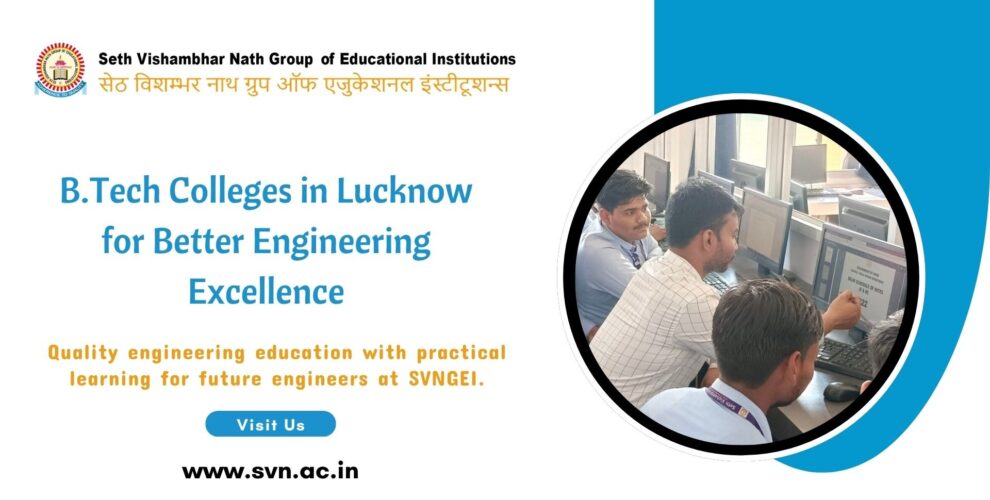
B.Tech Colleges in Lucknow: A Complete Guide to Choosing the Right Engineering College
Picking an engineering college isn’t just about ticking a box on your admission form — it’s a decision that quietly shapes the next four years of your life, and honestly, a good chunk of your career after that too. If you’re scrolling through options for B.Tech colleges in Lucknow, you’ve probably already noticed how similar most of the brochures sound. So let’s cut through that and talk about what actually matters.
What Should You Really Be Looking At?
Forget the glossy photos for a second. When you strip a college down to what it actually offers, a few things separate the ones worth your time from the ones that aren’t:
- Faculty who’ve actually worked in the field, not just taught from a textbook
- Labs that are used regularly, not locked and shown only during campus tours
- A curriculum that leaves room for projects, not just semester-end exams
- Mentors you can walk up to when you’re stuck, academically or otherwise
- Some real connection to the industry — internships, guest lectures, live projects
If a college checks most of these, it’s already ahead of a lot of the competition.
Why Classroom Learning Isn't Enough Anymore
Here’s the thing about engineering — you can memorize every formula in a textbook and still freeze the first time you’re asked to debug a real circuit or fix a piece of code that’s throwing errors for no obvious reason. That gap between “knowing” and “doing” is exactly what labs, workshops, and industrial visits are meant to close.
Students who get their hands dirty early — building small projects, attending workshops on new tools, sitting through a few failed experiments before getting one right — end up far more confident walking into an interview than someone who’s only seen engineering on a slide.
Choosing a Branch That Actually Fits You
Engineering isn’t one thing anymore. The options have spread out a lot, and each one leads somewhere different:
- Computer Science & Engineering (CSE) — for people who enjoy building software and solving logic puzzles
- CSE (AI/ML) — for students interested in artificial intelligence, machine learning, intelligent systems, and emerging technologies
- Mechanical Engineering — for those who like understanding how machines actually work
- Civil Engineering — for anyone drawn to infrastructure, construction, and design
- Electrical Engineering — power systems, circuits, and everything that runs on electricity
- Biotechnology — where biology meets applied science
None of these is “better” than the others — it really comes down to what you enjoy doing on a Sunday afternoon out of curiosity, not obligation.
Why Students Consider SVNGEI
Seth Vishambhar Nath Group of Educational Institutions (SVNGEI) has built its reputation around one simple idea — engineering education should prepare you for the real world, not just for exams. The focus stays on experienced faculty, functional labs, and a teaching approach that doesn’t stop at theory.
Beyond the classroom, SVNGEI pushes students toward technical events, workshops, and collaborative projects — the kind of experiences that build both technical skill and the soft skills nobody teaches you directly, like communication and teamwork.
Where Practical Learning Actually Pays Off
There’s a reason recruiters ask about projects before they ask about your CGPA. Practical exposure — lab work, workshops, live industry projects — is where students start connecting dots between what they studied and what actually happens on the job.
It also does something less obvious: it builds the kind of confidence that only comes from having tried, failed, and fixed something yourself. That’s not something a textbook can hand you.
What Comes After B.Tech?
A B.Tech degree opens more doors than most students realize at the start. Depending on your specialization, you could end up in:
- Software Development
- Web Development
- Civil Engineering & Construction
- Mechanical Design
- Electrical Systems
- Quality Engineering
- Project Management
- Research & Development
- Technical Consulting
And if you’d rather keep studying, a postgraduate degree can help you specialize further or pivot into a niche you discovered you love along the way.
The Real Benefits of an Engineering Degree
Beyond the job title, here’s what a solid engineering education actually builds in you over time:
- A technical foundation you can rely on
- The ability to break down problems logically
- Better communication — you’ll need to explain complex ideas simply
- Comfort working in teams, and sometimes leading them
- Exposure to tools and technologies before most people even hear of them
- A mindset that’s ready to keep learning, because engineering never really stops changing
Growing Beyond Academics at SVNGEI
Good engineers aren’t made in classrooms alone. At SVNGEI, seminars, workshops, and project presentations are treated as seriously as regular coursework — because confidence in front of a room, or in a team meeting, matters just as much as knowing your subject.
The goal isn’t just a degree at the end of four years — it’s a student who walks out ready, not just qualified.
Choosing among the B.Tech colleges in Lucknow isn’t about picking the one with the best-looking website — it’s about finding a place where the faculty actually teach, the labs actually work, and you’re pushed to build real skills alongside your degree. SVNGEI’s approach centers on exactly that: practical learning, genuine mentorship, and an environment built to get students ready for what comes after college, not just through it.
Frequently Asked Questions
It’s a four-year undergraduate engineering degree that combines technical theory with practical, hands-on learning across various specializations.
Look closely at the faculty’s real-world experience, how functional the labs actually are, the kind of practical exposure offered, and whether there’s genuine mentorship available — not just on paper.
Because textbooks can only take you so far. Labs, workshops, and real projects are where theoretical knowledge turns into actual skill.
For the combination of experienced faculty, working labs, and a genuine push toward practical, project-based learning alongside academics.
Careers span software, civil and mechanical engineering, electrical systems, research, biotechnology, and more — the range is wider than most students expect going in.
Yes — a postgraduate degree is a common next step for students who want to specialize or explore a niche within their field further.