

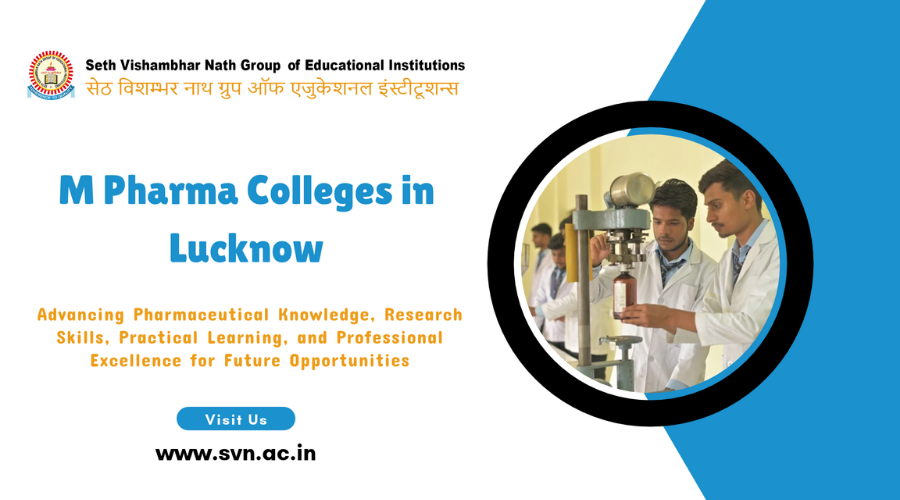
M. Pharm Colleges in Lucknow: Pharmaceutical Education at SVNGEI
Choosing an institution for postgraduate pharmacy education is an important step for students who want to continue their studies in pharmaceutical sciences. When exploring M. Pharm Colleges in Lucknow, students can consider the available specialisations, faculty guidance, practical learning, research, and academic approach before making a decision.
Seth Vishambhar Nath Group of Educational Institutions (SVNGEI) provides pharmacy education through its Department of Pharmacy. The department offers D.Pharm, B.Pharm, and M.Pharm programmes, including postgraduate specialisations in Pharmaceutics and Pharmacology. Its educational approach focuses on structured teaching, theoretical knowledge, practical training, research, and professional skill development.
M.Pharm Courses at SVNGEI
The Department of Pharmacy offers M.Pharm programmes in two specialisations: Pharmaceutics and Pharmacology. These subjects represent different areas of pharmaceutical science and allow students to continue their studies according to their academic interests.
Pharmaceutics covers pharmaceutical formulations and related areas of study, while Pharmacology focuses on the study of drugs and their effects. Both subjects form important parts of pharmaceutical education.
Along with postgraduate courses, the department offers D.Pharm and B.Pharm programmes. Students exploring the Top M. Pharm Colleges in Lucknow can review the available specialisations and academic objectives to understand which programme aligns with their interests.
The pharmacy programmes include:
- M.Pharm in Pharmaceutics
- M.Pharm in Pharmacology
- B.Pharm
- D.Pharm
This range of programmes reflects the department’s focus on pharmacy education at different academic levels.
Faculty Guidance and Academic Learning
Faculty guidance plays an important role in helping students understand specialised pharmaceutical subjects. The Department of Pharmacy has qualified and experienced faculty members from different disciplines, including Pharmaceutics, Pharmacology, Pharmaceutical Chemistry, and Pharmacognosy.
Faculty members participate in faculty development programmes, seminars, conferences, and workshops. These activities support continued academic development and help faculty members remain informed about their respective fields.
The department focuses on a structured teaching and learning system supported by qualified staff. Its educational objectives include developing subject knowledge and providing hands-on training in core areas of pharmacy.
Important aspects of academic learning include:
- Understanding pharmaceutical concepts through structured teaching.
- Receiving academic guidance from faculty members.
- Developing analytical and subject-related knowledge.
- Gaining practical understanding of core pharmacy disciplines.
These areas support students as they work towards their academic and professional goals.
Practical Learning and Pharmaceutical Knowledge
Practical learning is an important part of pharmacy education because students need to understand concepts as well as their practical applications. The Department of Pharmacy aims to provide theoretical and practical knowledge in Pharmaceutics, Pharmaceutical Chemistry, Pharmacology, and Pharmacognosy.
These disciplines cover different aspects of pharmaceutical science. Studying them helps students develop a broader understanding of the field and its subject areas.
The department’s educational objectives include providing hands-on training in core areas of pharmacy. Practical learning supports the development of technical knowledge and gives students opportunities to strengthen their understanding of subjects covered during their studies.
Practical and theoretical learning can help students work towards:
- Building a better understanding of pharmaceutical subjects.
- Developing technical knowledge.
- Strengthening analytical abilities.
- Connecting academic concepts with practical learning.
At Seth Vishambhar Nath Group of Educational Institutions (SVNGEI), the Department of Pharmacy places importance on structured education and practical knowledge as part of its approach to pharmaceutical studies.
Research and Industry-Oriented Education
Research and industry-oriented education are important parts of the department’s stated objectives. Its approach focuses on developing technically sound professionals through structured teaching, pharmaceutical knowledge, and research.
The department aims to introduce students to relevant tools and techniques used in pharmacy. This focus supports their understanding of the technical aspects of pharmaceutical science.
Industry interaction is another part of its mission. The department aims to support the development of employability and entrepreneurship skills through industry-oriented learning. These objectives connect academic knowledge with professional skills.
The department’s focus includes:
- Developing technical knowledge related to pharmacy.
- Encouraging research and further learning.
- Introducing students to relevant tools and techniques.
- Supporting industry interaction.
- Developing employability and entrepreneurship skills.
These objectives form part of the department’s approach to pharmaceutical education and professional development.
Communication and Analytical Skills
Pharmacy education also involves developing skills that support academic and professional responsibilities. Communication, planning, analytical thinking, leadership, and problem-solving are among the abilities identified in the Department of Pharmacy’s educational objectives.
Effective communication helps students explain ideas and share information clearly. Analytical abilities support the examination of information and the development of reasoned conclusions. Planning and problem-solving skills help students approach tasks in an organised manner.
The department also aims to encourage teamwork and leadership qualities. These skills are relevant to collaborative learning and professional responsibilities.
The key areas of skill development include:
- Effective communication.
- Analytical thinking and problem-solving.
- Planning and leadership.
- Teamwork and collaboration.
- Ethical and professional responsibility.
Alongside pharmaceutical knowledge, these skills contribute to the department’s aim of developing technically capable and professionally responsible graduates.
Professional Responsibility and Lifelong Learning
Professional responsibility is an important part of the department’s educational approach. Its stated objectives include developing ethical values, social responsibility, and an understanding of the role of pharmacy in society.
The department’s vision focuses on quality pharmacy education and the development of skilled professionals who can meet industry expectations. Its mission also includes encouraging problem-solving, leadership, teamwork, and ethical responsibility.
Lifelong learning is another objective. Continued learning allows students and professionals to keep developing their knowledge and remain aware of technological developments related to their field.
The department aims to motivate graduates to pursue higher education and update their knowledge as technology advances. This focus is relevant for students who wish to continue their academic development after completing a programme.
Choosing a Private M.Pharm College in Lucknow
Students comparing Private M. Pharm Colleges in Lucknow can review the available specialisations, faculty expertise, teaching methods, practical training, and research objectives. These factors can help them understand the academic opportunities available at different institutions.
Consider the following points when reviewing a postgraduate pharmacy programme:
- Course specialisation: Understand the subjects offered and choose according to academic interests.
- Faculty expertise: Review the department’s faculty and areas of teaching.
- Teaching approach: Consider structured instruction and academic guidance.
- Practical training: Review the emphasis on practical knowledge and hands-on learning.
- Research: Understand the department’s stated research objectives.
- Professional development: Consider communication, analytical thinking, teamwork, and ethical responsibility.
Reviewing these aspects can help students make an informed decision about their postgraduate pharmacy education.
Why Consider SVNGEI for Pharmacy Education?
Seth Vishambhar Nath Group of Educational Institutions (SVNGEI) offers pharmacy programmes through its Department of Pharmacy, including M.Pharm specialisations in Pharmaceutics and Pharmacology. The department also offers D. Pharm and B. Pharm courses.
Its academic approach focuses on structured teaching, faculty guidance, theoretical knowledge, practical training, and research. Industry-oriented education is another stated objective, along with the development of technical and professional skills.
The department also identifies communication, analytical thinking, teamwork, leadership, and ethical responsibility as important areas of student development. Its vision emphasises quality pharmacy education and the preparation of skilled professionals.
Students can review these programmes and objectives to understand the department’s approach before selecting a postgraduate course. Considering their academic interests and the specialisations offered can help them assess whether the programme suits their educational goals.
Conclusion
Selecting a suitable institution for postgraduate pharmacy education requires careful consideration of its courses, faculty guidance, teaching methods, practical training, and research objectives. These factors help students understand the academic opportunities available to them.
Seth Vishambhar Nath Group of Educational Institutions (SVNGEI) offers M.Pharm programmes in Pharmaceutics and Pharmacology through its Department of Pharmacy. The department focuses on structured education, theoretical and practical knowledge, research, industry-oriented learning, and professional skill development.
Students can review these offerings and the department’s educational objectives when deciding on their next step in pharmaceutical science. Understanding the available specialisations and learning approach can help them make a suitable choice for their postgraduate studies.
Frequently Asked Questions
The Department of Pharmacy at SVNGEI offers M.Pharm specialisations in Pharmaceutics and Pharmacology.
The department also offers B. Pharm and D. Pharm programmes alongside its M. Pharm courses.
The department’s teaching areas include Pharmaceutics, Pharmacology, Pharmaceutical Chemistry, and Pharmacognosy.
Yes. The department identifies theoretical knowledge and hands-on training in core areas of pharmacy as important parts of its educational objectives.
The department aims to develop analytical thinking, communication, problem-solving, leadership, teamwork, and an understanding of ethical and professional responsibilities.