

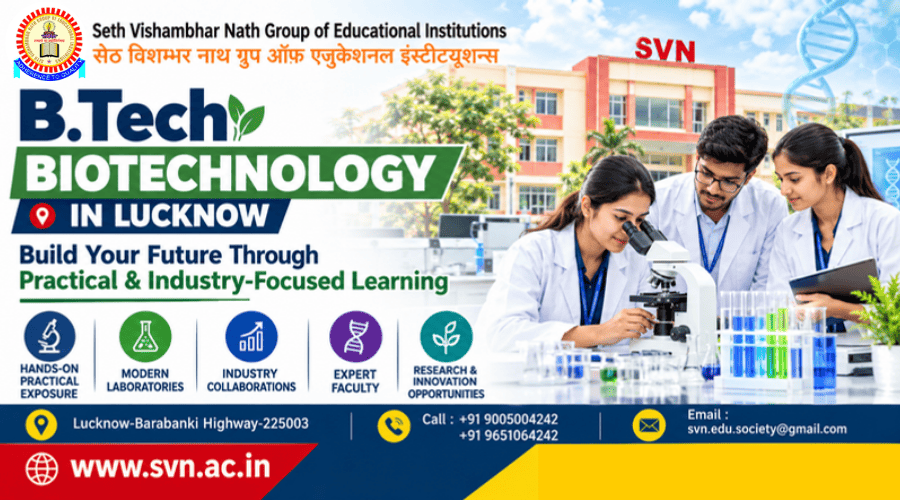
B.Tech. Biotechnology: Building Knowledge Through Focused Learning and Practical Exposure
Biotechnology brings together biological sciences and engineering knowledge to develop useful products, technologies, and solutions. The B.Tech. – Biotechnology program at Seth Vishambhar Nath Group of Educational Institutions (SVNGEI) provides students with a focused academic environment for learning biotechnology concepts, developing technical understanding, and gaining practical exposure. It is a four-year undergraduate program in Biotechnology Engineering.
The Department of Biotechnology has been offering the program since 2011 and follows the curriculum of Dr. A.P.J. Abdul Kalam Technical University (AKTU), Lucknow, Uttar Pradesh. The program gives importance to theoretical knowledge, scientific understanding, research learning, practical activities, and skill development. Through classroom learning, laboratory work, projects, and industrial visits, students get opportunities to understand different areas related to biological engineering.
The learning approach also focuses on developing problem-solving abilities, communication, teamwork, experimentation, data analysis, and professional development. Students are encouraged to understand biotechnological tools and techniques while developing the ability to apply engineering principles to biological systems.
Understanding the Program
The program is designed to provide knowledge related to biotechnology and biological engineering. It gives importance to fundamental sciences and engineering concepts along with advanced biological sciences. The academic approach combines theoretical learning with practical activities, experiments, projects, and industrial visits.
Key areas of learning include:
- Fundamental sciences and engineering concepts
- Advanced biological sciences
- Biotechnology tools and techniques
- Problem-solving and experimentation
- Data analysis
- Communication and teamwork
- Professional development
- Research-oriented learning
- Biotechnology-based entrepreneurship
This combination allows students to develop scientific understanding while gaining practical experience related to different areas of biological engineering.
Academic and Practical Learning
Practical exposure is an important part of learning at the Department of Biotechnology. Students participate in laboratory activities, mini projects, major projects, and industrial visits that support their academic understanding. The department has well-equipped laboratories, classrooms, a library, qualified and experienced faculty, and supporting staff.
The laboratories include:
- Analytical Techniques in Biotechnology
- Microbiology
- Biochemistry
- Genetics and Molecular Biology
- Immunology
- Enzyme Engineering
- Genetic Engineering
- Bioinformatics
- Bioprocess Engineering
- Plant Biotechnology
- Fermentation Biotechnology
- Environmental Biotechnology
- Bioseparation and Downstream Processing
The Enzyme Engineering Lab helps students learn about enzyme structure, function, activity, kinetics, and stability through molecular biology, biochemistry, and related techniques. The Plant Biotechnology Lab provides learning related to tissue culture, genetic engineering, and gene editing. The Bioinformatics Lab focuses on computational methods used to analyse and interpret biological data, including genetic and genomic information.
Different Areas of Biotechnology Learning
Biotechnology education covers different areas connected with biological sciences, engineering, and practical applications. The department is involved in areas such as microbial technology, bioinformatics, animal and plant biotechnology, fermentation technology, pharmaceutical biotechnology, and new drug discovery.
Students can gain practical understanding through laboratory activities related to these areas. Enzyme Engineering introduces students to enzyme-related concepts, while Plant Biotechnology provides exposure to tissue culture, genetic engineering, and gene editing. Bioinformatics supports learning about computational methods for analysing biological information.
Such academic exposure helps students understand how different concepts are connected and how scientific and engineering knowledge can be used together.
Role of Laboratory Exposure
Laboratory learning supports classroom education by giving students opportunities to understand concepts through practical activities. Different laboratories provide exposure to microbiology, biochemistry, genetics, molecular biology, immunology, enzyme engineering, genetic engineering, bioinformatics, and other related areas.
Laboratory activities help students in:
- Understanding biotechnology concepts
- Developing experimentation skills
- Strengthening technical knowledge
- Learning biotechnology tools and techniques
- Understanding biological processes
- Developing problem-solving abilities
- Applying academic knowledge through practical activities
Mini and major projects are also part of practical learning. Through these activities, students can work with concepts studied during their academic journey and develop practical understanding through focused projects.
Research-Oriented Learning
Research-oriented education is an important part of the academic approach. Students are encouraged to develop scientific understanding and interest in research while studying biological engineering and related areas.
The learning environment supports this through practical activities, laboratory work, projects, and exposure to different fields. Students can develop an understanding of scientific methods and experimentation while exploring different areas of study.
The program also encourages innovation and interest in biotechnology-based entrepreneurship. This provides students with opportunities to develop their understanding beyond regular classroom learning.
Skill Development and Professional Preparation
Along with technical knowledge, the program focuses on skills that support academic and professional development. Communication, teamwork, data analysis, experimentation, and problem-solving are important parts of the learning process.
The department also encourages students to prepare for national-level examinations and provides remedial classes when required. Soft-skill and preparatory training further support communication, competitiveness, and professional confidence.
Important areas of development include:
- Technical understanding
- Practical abilities
- Communication skills
- Problem-solving skills
- Teamwork
- Professional confidence
- Competitive preparation
- Research understanding
These areas help students build a balanced foundation that includes both academic knowledge and practical abilities.
Industrial Visits and Project-Based Learning
Mini and major projects provide students with opportunities to apply their academic understanding through practical activities. Projects encourage students to work with subject concepts, develop problem-solving abilities, and strengthen technical understanding.
Industrial visits provide additional practical exposure beyond classroom and laboratory learning. They help students understand biotechnology-related working environments and connect academic concepts with practical exposure.
Together, projects and industrial visits contribute to a learning approach that combines classroom knowledge with practical activities.
Learning Opportunities in Lucknow
Students exploring biotechnology colleges in lucknow can consider the academic and practical learning environment provided through the Department of Biotechnology at SVNGEI. The program offers structured education with laboratory activities, projects, industrial visits, and research-oriented learning.
The department provides learning across different areas of biological engineering while supporting the development of technical knowledge, practical skills, problem-solving abilities, communication, and teamwork.
Career Areas After Biotechnology Education
The knowledge and practical exposure gained during the program can support students in exploring different professional areas. Career areas include:
- Biotech industry
- Pharmaceutical industry
- Scientific research laboratories
- Biomedical research
- Forensic sciences
- Process engineering
- Water technology
Some students may also choose higher studies to continue their academic learning in biotechnology and related areas.
Focused Learning Through Biotechnology Engineering
A biotech engineering college lucknow can provide an academic environment where biotechnology and engineering concepts are studied together. At SVNGEI, the Department of Biotechnology focuses on structured education, laboratory activities, projects, industrial visits, and skill development.
Students receive opportunities to develop technical understanding through classroom and practical learning. The combination of biological sciences, engineering concepts, laboratory exposure, and project-based activities supports their academic development.
Biotechnology Education at SVNGEI
Seth Vishambhar Nath Group of Educational Institutions (SVNGEI) supports the Department of Biotechnology through structured academic learning, practical exposure, laboratory activities, projects, industrial visits, and training programs.
Qualified and experienced faculty, supporting staff, classrooms, laboratories, and library facilities contribute to the learning environment. Remedial classes and preparatory training support students in their academic and professional development.
The overall learning approach focuses on biotechnology concepts, practical skills, technical knowledge, communication, teamwork, research understanding, and professional confidence.
Practical Areas Available for Students
The department provides exposure to several practical areas:
- Microbiology: Learning related to microbial technology and practical understanding.
- Biochemistry: Understanding biochemical concepts and related techniques.
- Genetics and Molecular Biology: Learning related to genetics and molecular-level concepts.
- Enzyme Engineering: Understanding enzyme structure, function, activity, kinetics, and stability.
- Genetic Engineering: Exposure to genetic engineering techniques.
- Bioinformatics: Learning computational methods for analysing and interpreting biological data.
- Plant Biotechnology: Practical exposure to tissue culture, genetic engineering, and gene editing.
- Fermentation Biotechnology: Learning related to fermentation technology.
- Environmental Biotechnology: Understanding concepts related to environmental biotechnology.
- Bioprocess Engineering: Learning related to bioprocess concepts.
- Bioseparation and Downstream Processing: Understanding related biotechnology processes.
- Analytical Techniques in Biotechnology: Learning analytical techniques used in biotechnology.
This variety of practical areas gives students opportunities to develop a broader understanding of the subject and its different academic applications.
Developing Technical and Professional Confidence
Technical education is supported by professional development through practical activities, projects, industrial visits, and training. Students work on communication, teamwork, experimentation, data analysis, and problem-solving skills alongside their technical learning.
The department also encourages innovation and biotechnology-based entrepreneurship. This approach helps students develop technical understanding while building professional confidence for their academic and future professional journey.
Choosing a Suitable Academic Environment
Students searching for Top biotechnology colleges in lucknow often look for an academic environment that supports theoretical learning along with practical exposure. The Department of Biotechnology at SVNGEI provides structured education through classrooms, laboratories, projects, industrial visits, and training.
The focus on biological engineering, practical activities, research-oriented learning, technical understanding, and professional skills supports students in building an academic foundation in this field.
Conclusion
The B.Tech. – Biotechnology. program at Seth Vishambhar Nath Group of Educational Institutions (SVNGEI) provides a focused approach to education through theoretical learning, practical exposure, laboratory activities, projects, industrial visits, and research-oriented learning. The four-year undergraduate program follows the AKTU curriculum and has been offered by the Department of Biotechnology since 2011.
With exposure to microbiology, biochemistry, genetics and molecular biology, enzyme engineering, genetic engineering, bioinformatics, plant biotechnology, fermentation biotechnology, and related fields, students can develop technical understanding and practical abilities. The department also supports communication, teamwork, professional confidence, remedial learning, and preparatory training.
Through structured learning and practical activities, SVNGEI provides students with an academic foundation and professional abilities for further learning and opportunities in biotechnology and related areas.
Frequently Asked Questions
The B.Tech. – Biotechnology program is a four-year undergraduate program in Biotechnology Engineering. It focuses on biotechnology knowledge, engineering concepts, scientific understanding, practical learning, research, and skill development.
The Department of Biotechnology has been offering the B.Tech. – Biotechnology program since 2011.
The program follows the curriculum of Dr. A.P.J. Abdul Kalam Technical University (AKTU), Lucknow, Uttar Pradesh.
Students receive practical exposure through biotechnology laboratories, mini and major projects, industrial visits, and practical activities related to different areas of biological engineering.
Students can explore opportunities in the biotech industry, pharmaceutical industry, scientific research laboratories, biomedical research, forensic sciences, process engineering, and water technology. Some students may also choose higher studies.