

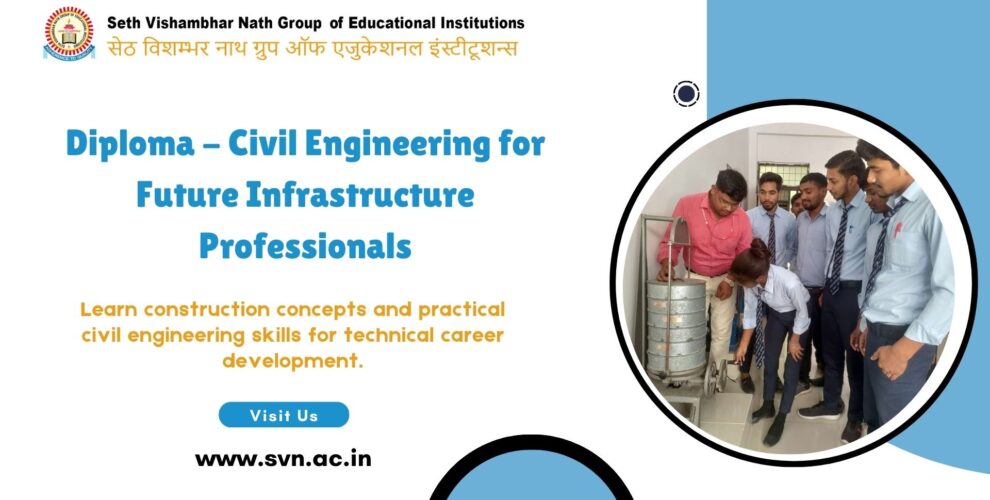
Diploma - Civil Engineering: Build Technical Knowledge with SVNGEI
Civil engineering plays a significant role in the development of infrastructure that supports modern society. Roads, bridges, buildings, and water management systems are all examples of projects that rely on civil engineering knowledge. Students who are interested in understanding how these structures are planned and developed often choose technical education in civil engineering. Programs such as Diploma – Civil Engineering help learners build a strong foundation in construction principles and infrastructure development.
Many students look for a civil engineering college in Lucknow that can provide practical knowledge along with academic learning. Choosing the right institute is important because technical education requires both theoretical understanding and hands-on experience. At SVNGEI, the Department of Civil Engineering focuses on providing an academic environment where students can understand engineering concepts and develop practical technical skills.
Understanding Civil Engineering Education
Civil engineering education introduces students to the concepts used in planning, designing, and maintaining infrastructure systems. A structured civil engineering course in Lucknow allows students to explore different areas of construction and engineering science.
During their studies, students learn several essential subjects that help them understand the fundamentals of civil engineering, including:
- Engineering mathematics
- Applied science concepts related to construction
- Surveying techniques used in infrastructure planning
- Construction materials and their properties
- Engineering mechanics and structural basics
These subjects create the foundation for understanding how civil engineering projects are designed and executed.
Learning Environment at SVNGEI
The Department of Civil Engineering at SVNGEI aims to support the academic and professional development of students. As a recognized civil engineering institute in Lucknow, the institute focuses on providing quality education supported by practical learning opportunities.
Students benefit from a supportive learning environment that includes:
- Guidance from experienced faculty members
- Academic programs designed to improve technical understanding
- Opportunities for practical training and project-based learning
- Support for skill development and professional growth
This environment helps students strengthen their knowledge and build confidence in their technical abilities.
Practical Learning and Industrial Exposure
Engineering education becomes more effective when students gain exposure to real engineering practices. Practical learning helps students understand how theoretical knowledge is applied in construction and infrastructure projects.
Students studying civil engineering are encouraged to participate in learning activities such as:
- Mini projects related to construction concepts
- Practical demonstrations of engineering techniques
- Exposure to construction methods
- Industrial training opportunities
These experiences help learners understand the practical side of engineering and develop confidence in applying technical concepts.
Laboratories and Practical Facilities
Practical training is an essential part of civil engineering education. The Department of Civil Engineering at SVNGEI provides laboratory facilities where students can conduct experiments and observe engineering processes.
Laboratory learning includes experiments in areas such as:
- Structural analysis
- Soil testing and geotechnical studies
- Hydrology and water resource analysis
- Environmental science experiments
- Engineering mechanics
Students also study the properties of construction materials used in infrastructure projects, including:
- Concrete
- Soil
- Steel
- Asphalt
Understanding these materials helps students recognize how different components behave in construction environments.
Computer-Aided Design and Technical Tools
Modern infrastructure projects rely on digital tools for planning and design. To support technical learning, SVNGEI provides computer laboratories where students can explore design software and analytical tools.
Students gain exposure to technical areas such as:
- Structural design analysis
- Geotechnical engineering applications
- Water resource management techniques
- Geomatics and surveying technologies
These tools help students understand how engineering designs are created and analyzed using modern technology.
Professional Skill Development
Technical knowledge is important for engineers, but professional skills are also necessary for career development. Students are encouraged to develop abilities that support teamwork and communication in professional environments.
Important skills promoted during the program include:
- Communication and presentation skills
- Team collaboration and coordination
- Problem-solving abilities
- Professional responsibility and ethics
These skills help students prepare for professional roles in the engineering and construction sector.
Continuous Learning and Academic Growth
Engineering fields evolve with the introduction of new technologies and construction techniques. To support academic growth, the Department of Civil Engineering at SVNGEI encourages students to participate in learning activities that expand their technical understanding.
Students may participate in:
- Academic discussions related to engineering topics
- Technical learning sessions
- Training programs that improve practical knowledge
Continuous learning helps students remain informed about developments in engineering practices.
Career Opportunities in Civil Engineering
Civil engineering education prepares students to understand infrastructure development and construction processes. Students who complete technical programs gain knowledge that can be applied in construction environments and engineering support roles.
Civil engineering professionals may participate in activities such as:
- Supporting infrastructure development projects
- Assisting in construction planning
- Participating in engineering operations
- Contributing to design and technical processes
These roles allow individuals to apply their technical knowledge to real-world engineering work.
Contribution of Civil Engineering to Society
Civil engineering contributes significantly to the growth of cities and communities. Infrastructure projects help improve transportation, housing, and water management systems.
Civil engineers contribute to projects that support:
- Transportation networks such as roads and bridges
- Residential and commercial infrastructure
- Water supply and drainage systems
- Urban development and city planning
Through engineering knowledge and technical planning, infrastructure development becomes possible and sustainable.
Role of SVNGEI in Civil Engineering Education
SVNGEI focuses on supporting technical education through practical training and academic guidance. As a learning institution dedicated to engineering education, the institute encourages students to develop both knowledge and technical skills.
Students studying civil engineering benefit from:
- Laboratory facilities for practical learning
- Academic guidance from faculty members
- Opportunities to develop technical and professional abilities
- Exposure to engineering concepts through structured learning programs
This balanced approach helps learners understand engineering principles and apply them effectively.
Conclusion
Civil engineering remains one of the most important fields responsible for building and maintaining infrastructure systems. Technical education allows students to understand construction processes, engineering materials, and structural principles.
Students interested in pursuing engineering education often search for a civil engineering college in Lucknow that provides both academic learning and practical exposure. Institutions such as SVNGEI, recognized as a civil engineering institute in Lucknow, aim to support students through structured learning programs and technical training.
Through a well-designed civil engineering course in Lucknow, students gain the knowledge required to understand engineering concepts and participate in infrastructure development. Programs such as Diploma – Civil Engineering provide the foundation needed to explore opportunities in the engineering and construction sectors.